
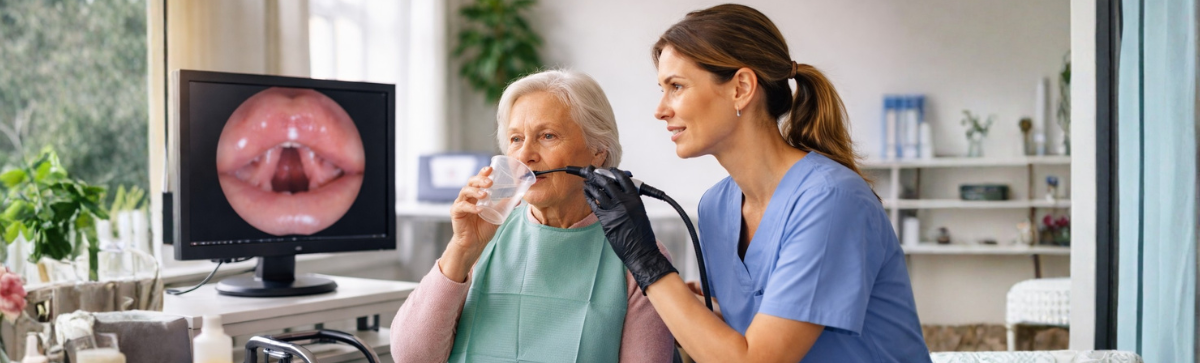
Have you ever watched a resident during a meal and wondered what is really happening when swallowing becomes difficult? The FEES swallowing evaluation is changing how providers assess and understand dysphagia, giving them a clearer picture of what residents experience every day.
Swallowing disorders are more common than many people realize, especially among older adults and those with neurological conditions. As a result, dysphagia can lead to serious complications, including weight loss, dehydration, and aspiration. In many cases, identifying the cause is not always simple. For example, some residents cannot tolerate traditional testing, and bedside evaluations do not always tell the full story.
There is some encouraging progress in this area. You may have seen that NYC Health + Hospitals/Carter is now using Flexible Endoscopic Evaluation of Swallowing, or FEES, to diagnose swallowing disorders in real time, giving clinicians the ability to actually see what is happening during the swallow instead of making assumptions.
And when you step back and look at how this works, it makes even more sense. The American Speech-Language-Hearing Association breaks down how FEES allows clinicians to view anatomy and function during swallowing, which helps explain why it can lead to more accurate diagnoses and better care planning.
If you are thinking about what this looks like in practice, this FEES clinical companion document walks through how providers can actually implement and interpret the evaluation, reinforcing the importance of training, collaboration, and ongoing assessment.
Ultimately, not every resident can participate in more complex testing, and not every swallowing issue looks the same. Because of this, tools like FEES matter. They allow care providers to see what is happening instead of relying only on observation or assumption.
As the use of FEES swallowing evaluation continues to expand, it creates new opportunities to improve diagnosis, guide interventions, and support better outcomes for residents living with dysphagia. In the end, it is one more example of how clinical insight and innovation can come together to enhance care.
Stay well and stay informed!